

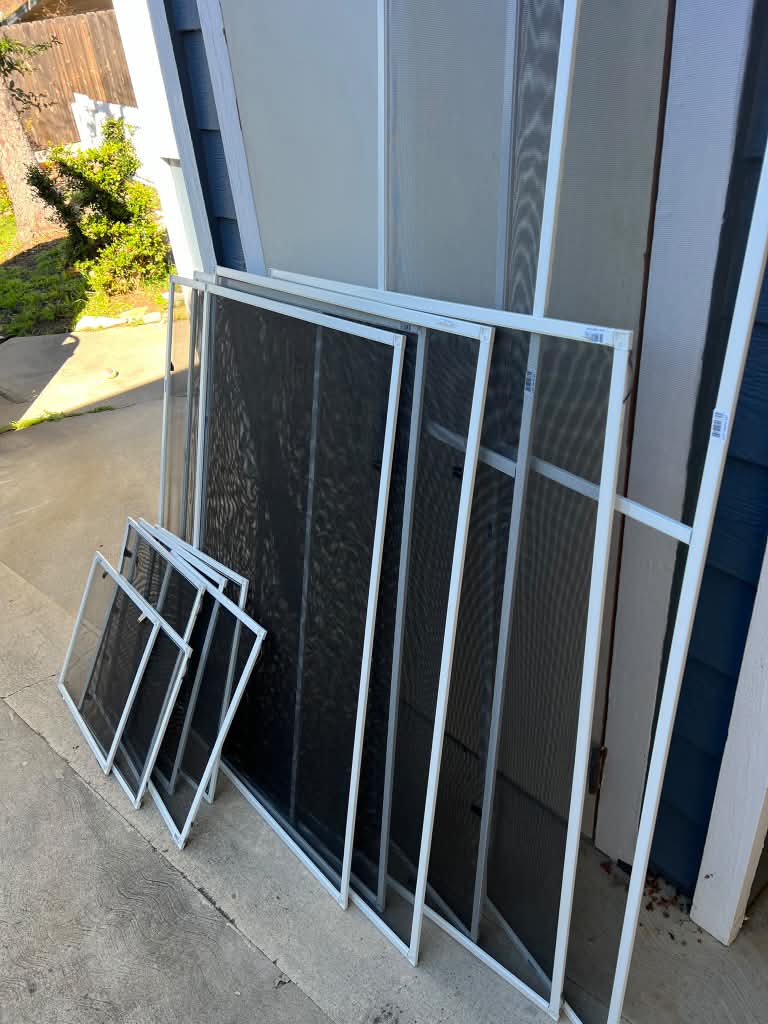
Why Is My Window Screen Sagging?
Fuad Atasoy4 min read
A sagging window screen is easy to live with for a while, but it only gets worse. Loose mesh flaps in the wind, catches on things, tears sooner and opens gaps at the edges where bugs get in.
Here is why window screens sag, how to tell the causes apart, and what it takes to stop a window screen from sagging for good.
Why window screens sag
- Spline that has dried out, shrunk or worked out of its groove, letting the mesh slip along one edge
- Mesh that has stretched with age and years of Florida sun and heat
- A dog, a cat or a hand pushing on the mesh from inside
- Mesh that was put in too loose when the window screen was made or last rescreened
- A frame that has bowed, which lets the mesh go slack across the middle
Where the sag is tells you a lot. Mesh loose along one edge points to the spline. Mesh that bellies out across the whole panel points to stretched or worn mesh. A sag with a curved frame points to the frame.
Loose along one edge: the spline
Spline is the rubber cord pressed into a groove around the frame to hold the mesh. In the heat it dries, shrinks and hardens, and once it loosens, the mesh creeps out of the groove a little at a time. Pushing old spline back in rarely holds for long, because it has shrunk. New spline in the right size grips the mesh again.
Sagging across the whole panel: the mesh
Fiberglass mesh stretches with age, and heat speeds that up. Re-tightening the same mesh can work for a while, but stretched, sun-worn mesh usually sags again. If it is also faded, stiff or torn, it is worn out, and new mesh is the fix.
When the frame is the problem
Frames bow when they are pushed, dropped or pried out of the window, and a bowed frame lets the mesh go slack. It also leaves gaps at the edges, so it lets bugs in even when the mesh looks fine. A slight bow can often be straightened. A frame that is kinked, creased or corroded needs window screen replacement.
How to stop a window screen from sagging
The fix that lasts is to put the mesh back under even tension, and that means starting again rather than tightening what is there. The old spline comes out of the groove, the frame is checked and straightened if it needs it, and the mesh is rolled in tight and even on all four sides with new spline, then trimmed. Done right, the mesh sits flat without pulling the frame out of shape.
If the mesh is still in good shape and only one edge has come loose, seating it again with new spline can be enough. If the mesh has stretched or worn, new mesh goes in at the same time. We will tell you which one your window screen needs.
Repair, rescreen or replace
A sag that comes from the spline or a slight bow in the frame is a window screen repair. Mesh that has stretched or worn out all over needs window rescreening, which keeps your frame. Our post on whether to repair, rescreen or replace a window screen goes through each case.
Sagging mesh on a sliding screen door
Sliding screen doors sag the same way, and sooner, because they are opened, closed and pushed on far more than any window screen. New mesh and spline in a sliding screen door are part of our sliding screen door repair, and the rollers and track can be checked on the same visit.
When to call
Call us if:
- The mesh is loose along an edge or bellies out across the panel
- It has been tightened before and sagged again
- The frame looks curved, or there are gaps at the edges
- Several window screens are sagging at once
- The mesh on the sliding screen door is loose as well
We fix sagging window screens at your home anywhere in Tampa Bay. Send a photo of the sag with your quote request, and we can usually tell you what it needs before we arrive. The quote is free.
See our window screen repair serviceWe come to you in Tampa, St. Petersburg, Clearwater, Brandon and Riverview, and across Tampa Bay.